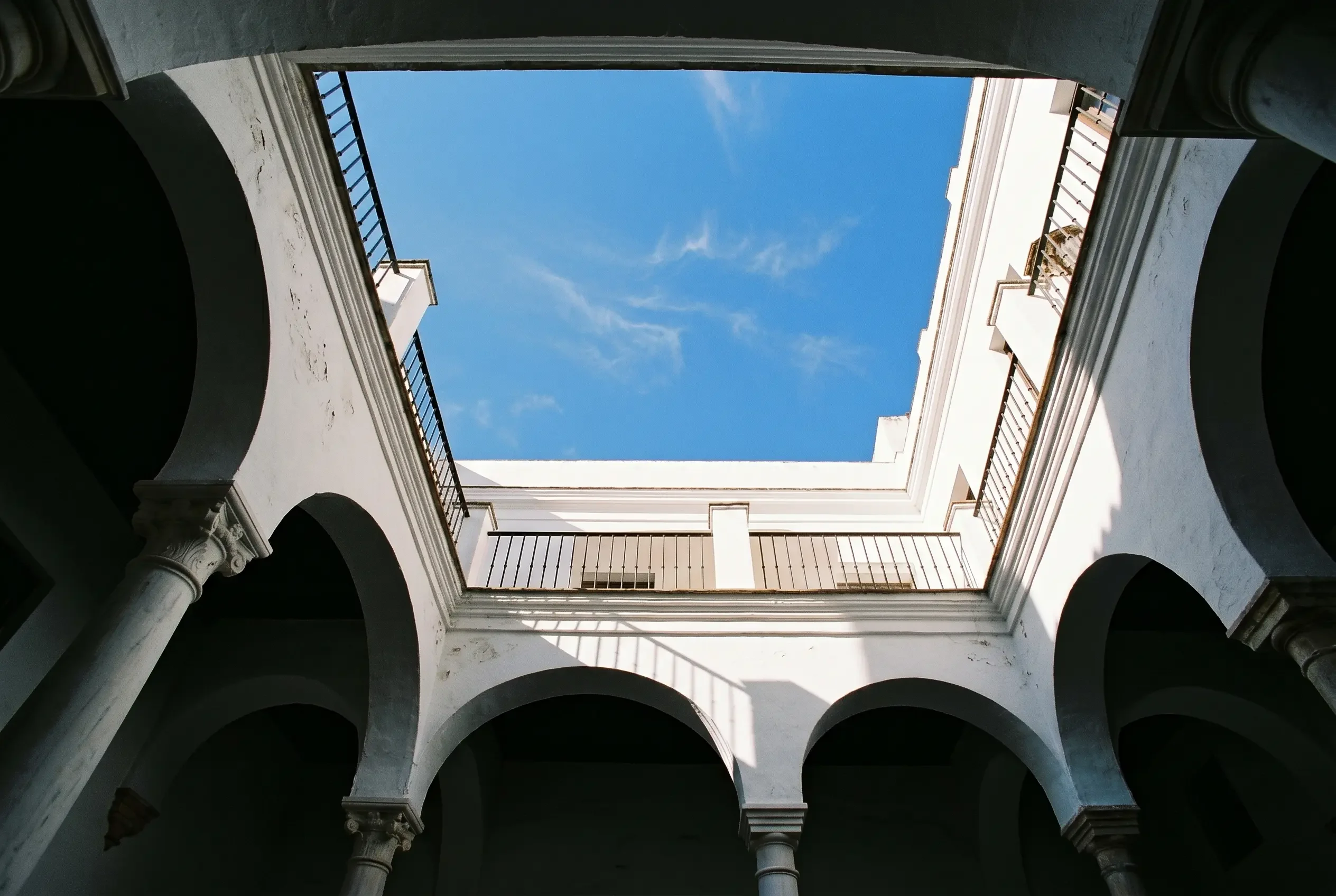
Before being an aesthetic decision, the Sevillian courtyard is a thermal response. Before being a tourist image, it is a machine.
The principle is simple. Hot air rises. Cool air falls. A house with a central courtyard open to the sky and ringed by galleries works as an inverted chimney during the day and as a coolness reservoir at night. The mass of the limewashed walls, the humidity tempered by a fountain or a plant, the awnings that cast shade at peak hours — the whole system is calibrated so the indoor temperature never reaches the outdoor one.
In August, in Seville, that means going from 42° on the street to 28° in the living room without touching a single appliance. It’s the difference between being able to live there and not.
The typology is not exclusively Andalusi or Roman or Greek or Mesopotamian. It belongs to all. The courtyard appears in any architecture born in hot, dry climates, from Damascus to Santa Fe. What happens in Andalusia is that the tradition was never fully cut. There are thousands of working courtyard houses, some preserved, many degraded, almost all restorable.
When Adarve takes on a courtyard house, the first thing is to understand the air cycle. Where it enters, where it rises, what stops it. Any intervention that breaks that cycle — a new roof over the courtyard, a partition closing the gallery — kills the system. And a dead system is replaced with air conditioning.
The paradox is this. The Sevillian courtyard house solves, without energy, what contemporary architecture solves at any cost. And yet we keep building new houses that need machines to be liveable in August.
There’s something to learn from that.